

When companies start measuring their greenhouse gas emissions, Scope 1 and Scope 2 are usually relatively straightforward.
Fuel consumed in company facilities and vehicles falls under Scope 1, alongside fugitive gases and process emissions. Scope 2 covers emissions from purchased electricity, steam, heating, and cooling.
Then comes Scope 3.
Scope 3 looks beyond a company's own operations and captures indirect emissions across its wider value chain, from the materials and services it purchases to transportation, business travel, product use, and end-of-life treatment.
For many businesses, this is where carbon accounting becomes significantly more complex. The data is often spread across procurement systems, invoices, suppliers, logistics providers, employees, and customers. Some information may be available in physical quantities, some only as financial data, and some may need to be estimated.
But this complexity shouldn't prevent companies from getting started.
A practical Scope 3 strategy begins with understanding which activities matter, estimating emissions with the best available data, identifying hotspots, and gradually improving data quality where it has the greatest impact.
What is Scope 3?
Under the GHG Protocol, corporate greenhouse gas emissions are divided into three scopes. Scope 1 covers direct emissions from sources owned or controlled by the company. Scope 2 covers indirect emissions associated with purchased electricity, steam, heating, and cooling.
Scope 3 covers other indirect emissions that occur throughout the company's value chain. These emissions occur at sources the reporting company does not own or directly control, but they are connected to its business activities.
This could include emissions generated when producing the steel a manufacturer purchases, transporting materials to its factory, employees travelling for business, customers using its products, or products being treated at the end of their useful life.
The GHG Protocol Corporate Value Chain (Scope 3) Standard organizes these emissions into 15 categories, providing companies with a structured framework for assessing their value chain.
The 15 Scope 3 categories
The categories cover both sides of the value chain: activities that happen before a company's own operations (upstream) and activities that happen after products or services leave the company (downstream).
Upstream and downstream activities
- Purchased goods and services
- Capital goods
- Fuel- and energy-related activities (not included in Scope 1 or Scope 2)
- Upstream transportation and distribution
- Waste generated in operations
- Business travel
- Employee commuting
- Upstream leased assets
- Downstream transportation and distribution
- Processing of sold products
- Use of sold products
- End-of-life treatment of sold products
- Downstream leased assets
- Franchises
- Investments
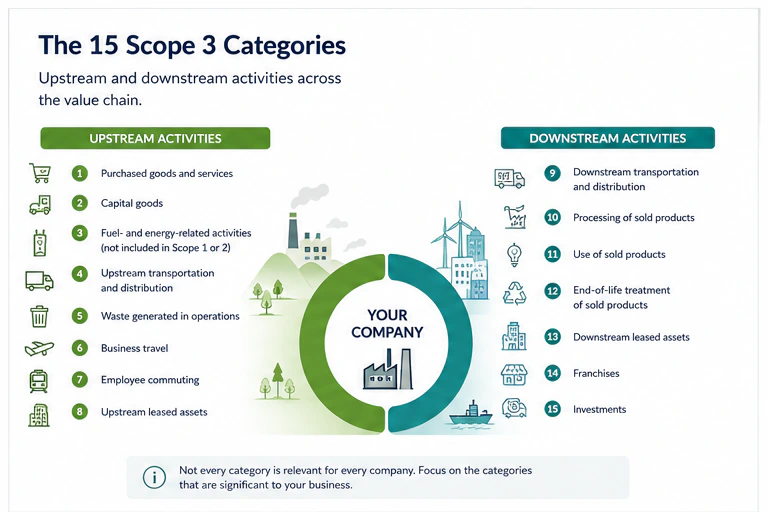
Not every category will be equally relevant to every company. A manufacturer purchasing large quantities of raw materials may have significant emissions in Category 1: Purchased goods and services, while a company selling energy-consuming equipment may find that Category 11: Use of sold products represents a much larger part of its footprint.
This is why Scope 3 accounting should not simply become an exercise in collecting as much data as possible. The goal is to understand where the significant emissions are and where better information can support better decisions.
Why is Scope 3 difficult to calculate?
The biggest challenge with Scope 3 is often not the calculation itself.
It is the data.
For Scope 1, a company might know exactly how many litres of diesel it purchased. For Scope 2, electricity consumption is normally available directly from utility bills or meters.
Scope 3 is different because much of the activity happens outside the reporting company's direct control. Imagine a manufacturer trying to calculate emissions associated with thousands of purchased components.
Some suppliers may provide product carbon footprints. Others may provide only the weight or composition of the material. Procurement may know the quantity purchased but not where it was produced. For some purchases, the only available information may be the amount spent.
The same problem appears throughout the value chain. Transport distances may need to be estimated. Employee commuting data may require surveys. Customers' use of products may need to be modelled using reasonable assumptions.
This is why Scope 3 does not require one single calculation method for every activity. The GHG Protocol provides different methods depending on data availability, data quality, significance of the emissions, and the effort required to obtain more specific information.
You don't need perfect data to start
One of the biggest mistakes companies can make is postponing Scope 3 accounting because they don't have supplier-specific data for every activity. In practice, Scope 3 inventories often develop over time.
A company might initially calculate parts of its footprint using industry averages or financial data. Once the first inventory is available, it can identify which categories, suppliers, materials, or activities contribute most significantly to total emissions.
Those areas can then become priorities for better data collection.
The GHG Protocol recommends screening Scope 3 activities first, using less specific data where necessary, and then refining estimates for categories that are significant or particularly relevant to the company's objectives.
A practical improvement cycle: Estimate → identify hotspots → improve data → recalculate → track progress.
Instead of trying to achieve perfect data coverage immediately, companies can focus their resources where better data will actually improve decision-making.
Spend-based vs activity-based calculations
Two terms frequently appear when companies begin calculating Scope 3 emissions: spend-based and activity-based methods. The difference comes down to what information is available.
Spend-based calculations
With a spend-based method, emissions are estimated using the economic value of a purchase. For example, if a company spends €50,000 on a particular category of goods, that expenditure can be matched with an environmentally extended input-output emission factor representing emissions per unit of economic value.
This can be particularly useful for screening large procurement datasets because financial information is often already available from accounting or ERP systems.
The limitation is that spend-based calculations are relatively broad. Two suppliers selling the same product at different prices can produce different calculated emissions even if the physical product is similar.
Activity-based calculations
An activity-based method uses physical activity data instead.
This generally provides a calculation more closely connected to the actual activity. GHG Protocol guidance for purchased goods and services distinguishes between supplier-specific, hybrid, average-data, and spend-based approaches, with more specific methods generally capable of providing higher-quality information but often requiring more effort to collect.
The GHG Protocol's Scope 3 Calculation Guidance makes an important point: companies don't necessarily have to choose one method for their entire inventory. Different methods can be appropriate for different categories and even for different activities within the same category.
Primary data vs secondary data
Another important distinction is between primary and secondary data.
Primary data comes directly from specific activities within the value chain. For example, a supplier might provide a verified Product Carbon Footprint for a component, or a logistics provider might provide actual fuel consumption or tonne-kilometres associated with shipments.
Secondary data comes from external sources such as lifecycle databases, industry averages, government datasets, or environmentally extended input-output databases.
Both have a role.
Secondary data makes it possible to build an initial Scope 3 inventory even when supplier-specific information is unavailable. Primary data becomes particularly valuable when a company wants to improve the accuracy of important emission sources, measure supplier-specific improvements, or track actual decarbonization progress.
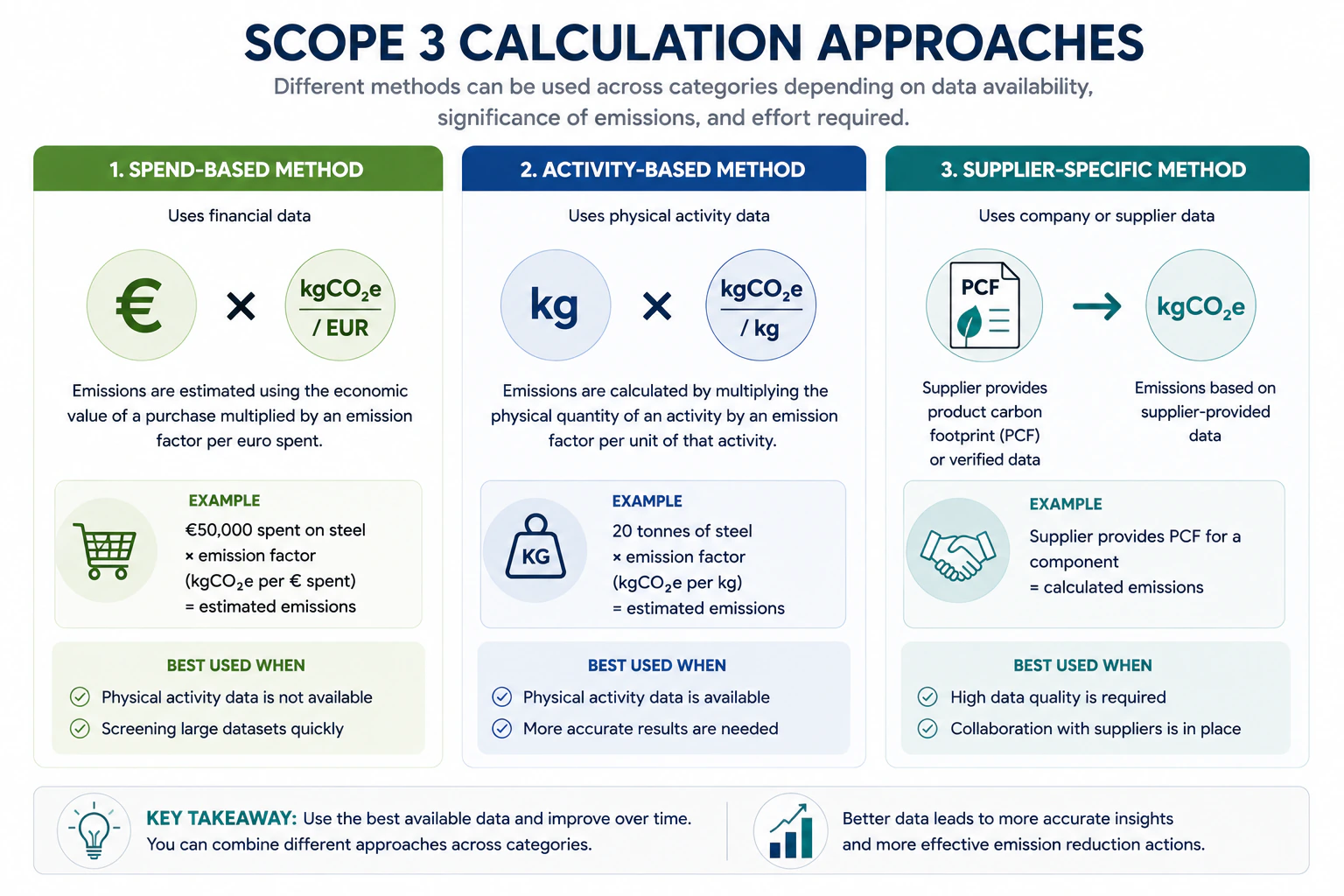
The objective isn't “primary data for everything.” Ask instead: Where would better data materially improve our decisions?
From calculation to supplier engagement
Scope 3 accounting becomes much more valuable when it moves beyond reporting.
Suppose the first inventory shows that purchased materials represent one of the company's largest emission sources. The next question shouldn't simply be, “How can we calculate this more precisely?” It should also be, “How can we reduce it?”
That could mean engaging strategic suppliers, requesting product-level emissions information, investigating alternative materials, changing specifications, or incorporating carbon performance into procurement decisions.
The same applies elsewhere in the value chain. High transport emissions may lead to changes in logistics. High use-phase emissions may create a business case for more energy-efficient products. Significant end-of-life emissions may influence product design and circularity strategies.
This is ultimately why companies calculate Scope 3 emissions in the first place.
The GHG Protocol identifies understanding value-chain risks and opportunities, identifying reduction opportunities, tracking performance, and engaging value-chain partners among the major objectives of Scope 3 accounting.
Scope 3 data should improve over time
A first Scope 3 inventory is rarely the final one. As companies mature, they can progressively replace assumptions and averages with more specific information.
For example, purchased materials might initially be calculated from procurement spend. Later, the company obtains quantities and calculates emissions based on kilograms of material purchased. Eventually, key suppliers may provide product-specific carbon footprint information.
The result isn't simply a more accurate carbon footprint. It also gives the company a better basis for measuring whether supplier engagement and decarbonization initiatives are actually reducing emissions.
From Scope 3 accounting to decarbonization
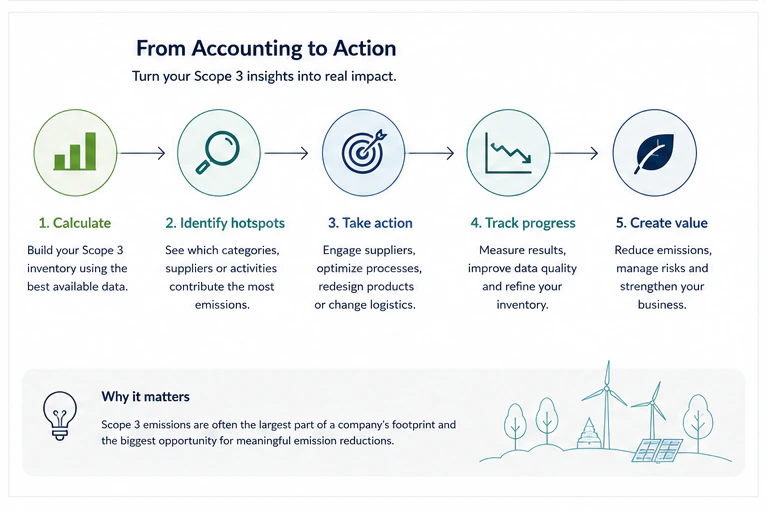
Calculating Scope 3 shouldn't end with a number in a sustainability report.
The real value comes from understanding what that number represents.
- Which categories dominate the footprint?
- Which suppliers or materials matter most?
- Where is primary data worth collecting?
- Which activities offer realistic reduction opportunities?
- Where can the company influence emissions even if it doesn't directly control them?
This is the shift from carbon accounting to carbon management.
A company doesn't need perfect information about every activity in its value chain to begin that process. It needs enough information to understand where to focus first.
How Verde365 helps companies manage Scope 3 emissions
At Verde365, we help companies calculate and manage greenhouse gas emissions across Scope 1, Scope 2, and Scope 3.
Our platform supports different levels of data maturity, allowing companies to begin with the information they already have and progressively improve their calculations as better data becomes available.
This includes working with procurement and accounting data, activity-based information, supplier data, and emission factor databases to build a structured corporate carbon footprint.
The objective isn't simply to calculate another number.
It's to help companies understand where their emissions come from, where better data matters, and where decarbonization efforts can have the greatest impact.
When it comes to Scope 3, you don't need perfect data to start. You need a structured way to start improving it.
Ready to make Scope 3 manageable?
Build a practical value-chain emissions baseline with the data you already have, identify the hotspots that matter, and improve accuracy over time with Verde365.